Research Article | | Peer-Reviewed

Effects of Picture Book Reading on Young Children’s Knowledge and Attitudes Toward Animals

Received: 28 October 2025     Accepted: 14 November 2025     Published: 17 December 2025
Views:       Downloads:
Abstract

Reading picture books to young children is expected to develop their cognition and imagination and contribute to the acquisition of their knowledge of and attitudes toward various things and phenomena. This study created a science picture book about guinea pigs and examined the effects of reading it on young children’s knowledge of and attitudes toward animals. Interviews were conducted with 81 five-year-old kindergarteners (47 boys and 34 girls) in pre- and post-reading sessions. Each child was asked about the physical characteristics and ecology of guinea pigs, proper care for them, and their attitudes toward guinea pigs and other animals. After reading, the children’s animal knowledge significantly improved, and more came to believe that all animals, including guinea pigs, had emotions. Regardless of the experience of keeping pets, the children deepened their knowledge and understanding of animals. Girls scored higher than boys in terms of knowledge of proper care. These findings suggest that picture books function effectively as a medium for developing knowledge of and empathic attitudes toward animals. Educators should focus more on knowledge of caregiving behaviors, especially for boys. Children can indirectly encounter animals through picture books, which foster their understanding of and empathy toward animals. Furthermore, the characteristics of guinea pigs as rodents appeared in the picture book, were considered to strengthen the effects on young children. These findings can contribute to the design of animal education programs that use picture books and educational materials for other animal species.

Published in International Journal of Literature and Arts (Volume 13, Issue 6)
DOI 10.11648/j.ijla.20251306.16
Page(s) 160-167
Creative Commons

This is an Open Access article, distributed under the terms of the Creative Commons Attribution 4.0 International License (http://creativecommons.org/licenses/by/4.0/), which permits unrestricted use, distribution and reproduction in any medium or format, provided the original work is properly cited.

Copyright

Copyright © The Author(s), 2025. Published by Science Publishing Group

Keywords

Attitudes Toward Animals, Gender Differences, Guinea Pigs, Knowledge About Animals, Picture Book Reading, Young Children

1. Introduction
1.1. Learning Effects of Picture Books
Picture books are effective tools for children’s learning in areas such as language, scientific concepts, problem-solving, and morality . Their narrative qualities, rhythmic words, and visually attractive illustrations capture child readers’ interests . The stories and characters in picture books foster children’s problem-solving skills and logical thinking, enhancing the cognitive functions that form the foundation for learning. In particular, the visual elements of picture books help children grasp abstract concepts, thereby improving their vocabulary and social skills . Reading picture books aloud enhances parents’ ability to engage with children through picture books and fosters positive parent-child interactions . It also strengthens parent-child communication and contributes to children’s mental stability . Children can learn deeply and concretely understand abstract concepts through being read picture books aloud by adults .
Science picture books serve as educational tools that stimulate readers’ interest in natural sciences and cultivate scientific thinking. By combining narratives and information, science picture books stimulate children’s curiosity, allowing them to acquire abstract scientific knowledge, enhance their interest in nonfiction texts, and improve their reading comprehension . Science picture books are not merely reading materials, but also serve as entry points for practical learning .
1.2. Effects on Children’s Knowledge and Attitudes Toward Animals
The depictions of animals in picture books stimulate children’s cognition of animals and support the acquisition of animal-related knowledge. Picture books promote the acquisition of biological knowledge with clear illustrations and attractive narratives in concise language . Animal knowledge in picture books does more than provide information; it also provides opportunities for a deeper, more integrated understanding. Picture books not only convey species names and appearances, but also illustrate the environment in which animals live and their habits, helping children obtain more profound insights into animals. Visual elements are important as they are the foundation for children to recognize and memorize animals accurately . Consequently, young children can apply knowledge gained from picture books to real animals . Animal picture books help children recognize life and foster an understanding of beings that are different from themselves through depictions of animal behaviors and traits.
Furthermore, the narratives in animal picture books stimulate children’s imaginations and provide valuable opportunities for building empathy and connections with others . Children over four years of age can learn animal traits and behaviors from picture books . Children aged 5-8 years can understand the fundamental principles of natural selection, such as evolution and heredity, through picture books .
Depictions of animal behaviors and emotions in picture books are expected to help children recognize both differences and similarities between humans and animals, enhancing human-animal relationships . The animals in picture books foster children’s empathic abilities and deepen their understanding of nature, society, and culture. However, stereotypical representations such as “Lion is majestic” and “Snake is evil” can create biases against specific animals. Therefore, picture book authors must pay attention to the importance of diversity and reality in animals and create works with educational value .
1.3. Gender and Attitudes Toward Animals
Gender differences in empathy are evident during early childhood . For example, preschool girls develop compassion earlier than boys . Among children aged 7–12 years, girls exhibit stronger attachment and compassion toward pets than boys . Among 5th- and 6th-grade elementary school students without pet-keeping experience, girls showed higher empathy and prosocial behavior than boys, but boys with pet-keeping experience scored equally well as girls . Women tend to show more interest in animals, whereas men are more likely to be indifferent or to express aversion . Women display more positive behaviors and attitudes and show greater empathy toward animals. However, some studies have reported that gender differences in empathy are insignificant .
1.4. Pet-Keeping Experience and Attitudes Toward Animals
Children who keep pets tend to develop deeper empathy and understanding of animals. Children with pet-keeping experience assign a higher moral value to various animals; for instance, they show favorable attitudes toward wild or less-liked animals . Thus, pets may broaden our overall understanding of animals. Kindergarteners who raise animals enhance their understanding and affection toward them, and foster attitudes that value their lives . Caring for animals with affection provides opportunities to deepen environmental awareness, learn about the importance of life, and cultivate empathy and prosocial behaviors , thereby promoting ethical attitudes toward animals.
2. Purpose of the Study
Previous studies have shown that animal picture books can promote children’s recognition of animals, facilitate their acquisition of animal-related knowledge, and enable them to apply such knowledge to real animals. Animals depicted in picture books not only influence children’s knowledge, but may also shape their images and values related to animals. Science picture books may cultivate children’s scientific knowledge and curiosity in educational settings. Information should be provided to authors to publish educationally valuable picture books, as well as to parents and educators to choose and use high-quality picture books.
This study created a science picture book about guinea pigs and read it aloud to preschoolers. Using interviews in pre- and post-reading sessions, we examined changes in children’s knowledge of and attitudes toward animals. This study also clarified the effects of gender and pet-keeping experiences on their knowledge and attitudes.
3. Method
3.1. Participants and Procedure
Participants were 81 five-year-olds (47 boys and 34 girls) from a kindergarten in China. The second author visited the kindergarten to conduct reading sessions and interviews from July to September 2024. Before reading, each child was interviewed. The picture book was then read to the children in class as a group activity. The following day, the second author conducted post-reading interviews with each child.
3.2. Picture Book
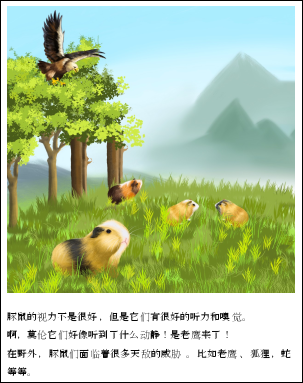
To minimize bias, this study focused on guinea pigs, which are relatively unfamiliar to Chinese preschoolers. Based on the existing knowledge about guinea pigs, we created the picture book “A Day of Moln, the Guinea Pig” (Figure 1) for this study. The book introduces information about guinea pigs by depicting a guinea pig named Moln, who spends time with her family members and friends; the book does not have any human characters. The story shows that the Moln family wakes up in the nest, goes out for meals, narrowly escapes a hawk attack by hiding in their friend’s burrow, and later goes out and plays happily with their friend’s family after the rain stops.
Figure 1. A Page of the Picture Book.
(Guinea pigs do not have very good eyesight. Instead, they are good at listening to the sounds and distinguishing the smells.
Oh! Moln and the others noticed a sound. Wow, a hawk is coming!
Outside the burrow, there are many predators of guinea pigs—hawks, foxes, snakes, and more…).
3.3. Interview Questions
Before the reading, children were asked about pet keeping (“Have you ever kept a pet?”) and knowledge of guinea pigs (“Do you know guinea pigs?”). A photograph of a guinea pig was shown to those who did not know it.
Before and after the reading, children answered the following questions: morphology of guinea pigs (6 items: “Do guinea pigs have tails?”, “How many toes do guinea pigs have on their front and back feet?”, “How many types of guinea pig fur exist?”, “How many colors of guinea pig fur exist?”, “Do guinea pigs have only one type of vocalization or more?”, and “Do guinea pigs’ teeth keep growing for life?”), proper care for guinea pigs (6 items: “Are guinea pigs brave or timid?”, “Do guinea pigs prefer to live alone or with family?”, “How long do guinea pigs live?”, “What foods do guinea pigs like?”, “Which season is comfortable for guinea pigs?”, and “Are there animals outside that eat guinea pigs?”), and attitudes toward guinea pigs (3 items: “Can guinea pigs learn their names?”, “Do you want to keep guinea pigs if you have a chance?”, and “Do guinea pigs have emotions like humans?”). For children who answered “Yes” to the last question about the guinea pigs’ emotions, follow-up open-ended questions were asked: “Why do you think so?” and “How about other animals?” Finally, the children were encouraged to talk freely about animals other than the guinea pigs. The picture books contained information or clues about the correct answers.
Responses regarding whether they had kept pets and whether they knew of guinea pigs were recorded as yes/no. The following 15 questions had two or three answer choices, scored as correct (1 point) or incorrect (0 points). Total scores were calculated for knowledge of morphology (0–6 points) and proper care (0–6 points). Attitude questions were also scored based on empathic responses: answering “Yes” to each of the three items yielded 1 point each (0–3 points total).
This study was approved by the Ethics Committee on Research Involving Human Participants of Tokyo University of Agriculture and Technology (240801-0624). Informed consent was obtained from all child participants and their parents.
4. Results
Of the participants, 29 (36%) had kept pets, but none had kept guinea pigs. Only three children (4%) knew guinea pigs, meaning that most were unfamiliar with them.
After reading, the children showed improved accuracy across all questions. For example, the percentage of correct answers to “How long do guinea pigs live?” increased from 17 to 67% (maximum change), while correct answers to “Which season is comfortable for guinea pigs?” increased from 53 to 65% (minimum change). The children looked like they found the reading session fantastic and actively participated in the interviews. For instance, when asked about the number of toes on the front and back feet of guinea pigs (three-choice question, i.e., a: front 4 and back 4; b: front 4 and back 3 (correct answer); c: front 5 and back 5), the children needed to carefully count the toes in the illustrations while listening to the researcher. The correct response rate rose from 40% (slightly above chance level) before reading to 72% after reading. In the second interview, many children deliberately said, “Front foot has 4 toes, and back foot has 3!” before the response options were presented. Similar trends were observed for other questions.
Attitudes toward guinea pigs also improved after reading. More children believed that guinea pigs could learn their names (48%–64%), wanted to keep guinea pigs as pets (52%–67%), and thought guinea pigs had emotions like humans (49%–77%). In addition, the number of children who believed that all animals had emotions increased (11% to 30%).
To examine changes by gender, a two-way repeated ANOVA was conducted with gender (boy/girl) and time (pre-/post-reading) as factors (Table 1). No significant interaction effects were found for the knowledge of morphology, proper care, or attitude. A main effect of gender was found for knowledge of proper care, with girls scoring higher than boys (F(1,79) = 4.00, p <.05). The main effects of time were significant for knowledge of morphology (F(1,79) = 153.00, p <.01), knowledge of proper care (F(1,79) = 131.94, p <.01), and attitude (F(1,79) = 33.04, p <.01). In all domains, the scores increased significantly after reading.
Table 1. Changes in Children’S Knowledge and Attitudes Toward Guinea Pigs before and after the Reading, by Gender.

Boys

Girls

Main effect of gender

Main effect of time

Interaction (gender×time)

Pre

Post

Pre

Post

Knowledge of morphology

2.57

4.87

2.03

4.91

1.56

153.00

1.95

(1.21)

(1.41)

(1.22)

(1.31)

(.22)

(<.01)

(.17)

Knowledge of proper care

2.96

4.83

3.38

5.18

4.00

131.94

0.06

(1.16)

(.99)

(1.30)

(1.00)

(<.05)

(<.01)

(.81)

Attitude

1.55

2.02

1.41

2.15

0.00

33.04

1.63

(1.10)

(.87)

(.92)

(.86)

(.97)

(<.01)

(.21)

Upper row: mean; values in parentheses: SD; for main effects and interactions, upper row: F value; values in parentheses: p-values.
Similarly, a two-way repeated ANOVA was conducted with pet-keeping experience (yes/no) and time (pre/post) as the factors (Table 2). No significant interactions or main effects of pet keeping were found for knowledge of morphology, proper care, or attitude. The main effects of time were again significant for knowledge of morphology (F(1,79) = 135.25, p <.01), knowledge of proper care (F(1,79) = 120.40, p <.01), and attitudes (F(1,79) = 32.04, p <.01). As with gender analysis, children scored significantly higher after reading in all domains.
Table 2. Changes in Children’S Knowledge and Attitudes Toward Guinea Pigs before and after the Reading, by Pet-keeping Experience.

Experienced

Not-experienced

Main effect of experience

Main effect of time

Interaction (experience×time)

Pre

Post

Pre

Post

Knowledge of morphology

2.41

4.93

2.31

4.87

0.17

135.25

0.01

(1.24)

(1.39)

(1.25)

(1.36)

(.68)

(<.01)

(.93)

Knowledge of proper care

3.38

5.00

3.00

4.96

1.07

120.40

1.09

(1.05)

(1.00)

(1.31)

(1.01)

(.30)

(<.01)

(.30)

Attitude

1.48

2.21

1.50

2.00

0.24

32.04

1.07

(1.06)

(.82)

(1.02)

(.89)

(.62)

(<.01)

(.30)

Upper row: mean; values in parentheses: SD; for main effects and interactions, upper row: F value; values in parentheses: p-values.
In the open-ended responses about animals, children with pet-keeping experience were more likely than children without experience to think that some animals had emotions, while others did not (34% vs. 10%). The children tended to attribute their emotions to the animals they had lived together. For example, children who had kept dogs believed that dogs had emotions, whereas those who had kept turtles believed that turtles had emotions but were uncertain about other animals. Pet keepers actively talked about their personal experiences with animals and shared their knowledge about them, whereas fewer non-keepers did (keepers: 90% vs. non-keepers: 65%). However, after reading, more children expressed their views about animals (keepers: 93% vs. non-keepers: 87%). The number of children who believed that all animals had emotions also increased (keepers: 7–24%; non-keepers: 13–33%). Among children whose attitude scores toward guinea pigs increased by 2 points or more after reading, comments included, e.g., “Guinea pigs cry when hurt” and “Guinea pigs sometimes feel joy, sadness, and anger.” Regarding other animals, they responded, e.g., “Dogs weep and have emotions” and “Dolphins are intelligent, have emotions, and can serve humans.”
5. Discussion
5.1. Effects on Knowledge About Animals
This study confirmed that specific information about animals’ physical traits and habits can be effectively conveyed to young children through picture-book reading, resulting in more accurate knowledge. Listening to an adult reading a picture book, with their peers in the classroom, seemed to be highly exciting for the children. Picture books, as simple learning materials, have considerable potential to promote child development. Picture books facilitate children’s acquisition of animal knowledge and support its transfer to real-world contexts . A combination of visual information and narratives may be effective for cognitive development. For children who cannot read fluently yet, illustrations serve as visual cues, helping them connect stories with concrete knowledge about animals, enhancing both comprehension and memory.
Children who were asked questions after reading the picture book showed better story comprehension than those who did not. Follow-up questions and dialogues with adults help children recall and understand the story . Eliciting children’s responses through activities such as questions, comments, and predictions is effective in linking the story content with children’s experiences. Through questioning and discussion, children deepen their understanding of the story and improve their ability to verbalize their knowledge . In this study, when the researcher mentioned that guinea pig teeth grow continuously throughout their lives, some children were asked whether the same applies to hamsters or rabbits. This finding suggests that dialogic interactions with adults can enrich the breadth and depth of children’s animal knowledge. Effective questioning and dialogue can enhance the learning benefits of picture books in both educational and home settings.
5.2. Effects on Attitudes Toward Animals
The reading sessions in this study promoted positive attitudes toward animals among the children, including familiarity and empathy. Yano insisted that animal picture books play an educational role by increasing children’s affection for and interest in animals. Nakagawa and Koda argued that depictions of animal emotions deepen children’s understanding of and engagement with animals. Picture books that portray animals as part of daily life can enhance children’s affection and influence how they interact with real animals .
People with positive attitudes toward animals also show greater empathy toward humans. This indicates that fostering empathy toward animals not only benefits animals but also strengthens morality and promotes prosocial behavior, thereby positively affecting human relationships . Thus, animal picture books can serve as valuable media for nurturing empathy in children.
5.3. Gender Factors
In this study, children of both sexes acquired animal knowledge and developed empathic attitudes through picture book reading. Fujisaki found no gender differences among under-6-year-olds in terms of preference, contact experiences, or biological knowledge of rabbits or grasshoppers. In early developmental stages, both boys and girls showed a strong interest in familiar animals. Thus, interest in and understanding animal picture books may be equally high across genders during early childhood.
However, in the present study, both before and after reading, girls demonstrated greater knowledge of proper animal care than boys. Girls tend to show more interest in animal-related occupations and coexistence with animals than boys . Girls are generally more empathic and compassionate than boys and may more easily identify emotionally with animal characters in picture books. Educators should place particular emphasis on the caregiving-related knowledge for boys.
5.4. Effects of Pet-Keeping Experience
Regardless of pet-keeping experience, the children in this study gained animal knowledge through picture books. Fujisaki compared children who liked grasshoppers to those who did not. Lovers of grasshoppers had more direct contact experiences and more knowledge, particularly regarding observable biological traits. Thus, direct experiences with animals influence children’s biological knowledge of these species. However, in this study, although some children had pets, only three knew anything about guinea pigs. Pet keepers may have had a more concrete understanding of familiar animals and more easily expressed opinions; however, after reading, both keepers and non-keepers increasingly responded that all animals had emotions, enhancing the generalization of understanding. Regardless of their experience in rearing animals, young children showed a strong interest in picture books about animals they were unfamiliar with and may have deepened their understanding of animals.
Experience rearing animals has the potential to positively affect children’s affection for animals and respect for life . However, with mere exposure, the effect is limited to species with which they have direct experience and cannot be generalized to all animals. Picture books can provide indirect encounters with animals that foster understanding and empathy, regardless of children’s prior direct experiences with pets. Urban children, who often lack opportunities to interact with various animals, may be easily influenced by media such as picture books . Although the participants in this study lived in the countryside, most had no knowledge of guinea pigs. Nonetheless, their enthusiastic responses suggest a readiness to embrace unfamiliar animals. With appropriate adult support, both direct and indirect experiences with animals may foster children’s awareness of animal welfare and conservation.
Pets positively influence children’s social and empathy abilities . Before reading, pet keepers were more likely than non-keepers to express their opinions, knowledge, and experiences regarding familiar animals. This may indirectly demonstrate that interactions with animals promote sociability among children.
5.5. Effects of Guinea Pigs
The significance of selecting guinea pigs for picture books without human characters should be discussed. Guinea pigs rarely appear in picture books. However, previous studies have shown that rodents (often mice) are easily anthropomorphized in picture books , and once anthropomorphized, they are unlikely to convert their forms into realistic ones in stories . They are less often assigned stereotypical roles, such as gender, and specific characters, such as protagonists or supporting characters . As small and vulnerable prey animals, rodents serve as accessible projection targets for young child readers who are still small and not yet fully capable .
In addition, rodents often appear in picture books where human protagonists travel to an unrealistic world, alleviating the anxiety and fear associated with the movement . In this study, guinea pigs were depicted in realistic forms as a science picture book, but their small, rounded baby schema likely enhanced these effects. In the story, the Moln family narrowly escaped the hawk by detecting danger early with their sharp hearing and darting into a small burrow. By reading this picture book, children may not only acquire scientific knowledge and attitudes toward coexistence with others, but also learn how to overcome challenges in accordance with their own capacities in their lives, and get opportunities to consider themselves as human beings by reflecting on guinea pigs.
6. Conclusion
This study examined the effects of reading a science picture book about guinea pigs to young children on their knowledge of and attitudes toward animals. After reading, children’s knowledge of guinea pigs increased significantly, and their attitudes toward coexistence with guinea pigs became more positive, regardless of gender or experience in keeping pets. These results highlight the usefulness of picture book reading in early childhood education. Girls had greater knowledge of proper animal care than boys. Therefore, focusing on knowledge related to caregiving behaviors, especially for boys, may be important.
7. Future Directions
The study was conducted at a single site. Further verification in other regions is necessary to confirm the generalizability of our results. Moreover, this study was limited to examining short-term effects on five-year-olds. Future studies should investigate the effects of continuous picture-book reading and compare the effects among children of different ages. Examining picture books of species other than guinea pigs is important. Future research should examine how picture books on biodiversity and animal conservation management may contribute to children’s environmental awareness and interest in nature.
Acknowledgments
This study was supported by the JSPS KAKENHI Grant (23K01930). The authors thank the kindergarten principal and staff members who cooperated in the experiment, as well as the children who participated. The authors are grateful to Ms. J. Cai for creating beautiful illustrations in the picture book. We also thank the beloved late guinea pig Moln, who served as the protagonist in the picture book.
Author Contributions
Mayuko Kato-Shimizu: Formal Analysis, Validation, Visualization, Writing – original draft
Yuanmeng Liu: Data curation, Investigation
Naoko Koda: Conceptualization, Funding acquisition, Methodology, Supervision, Writing – review & editing
Conflicts of Interest
The authors declare no conflicts of interest.
References
[1] Strouse, G. A., Nyhout, A., Ganea, P. A. The Role of Book Features in Young Children's Transfer of Information from Picture Books to Real-World Contexts. Frontiers in Psychology. 2018, 9, art. 50.
[2] Kelemen, D., Emmons, N. A., Schillaci, R. S., Ganea, P. A. Young Children Can Be Taught Basic Natural Selection Using a Picture-Storybook Intervention. Psychological Science. 2014, 25, 893-902.
[3] Chen, M., Huang, Y. Analysis on the Role of Picture Books in Children’s Cognitive Ddevelopment Education. Kuram ve Uygulamada Eğitim Yönetimi (Educational Administration: Theory and Practice). 2024, 30, 125-140.
[4] Dowdall N., Melendez-Torres G. J., Murray L., Gardner F., Hartford L., Cooper P. J. Shared Picture Book Reading Interventions for Child Language Development: A Systematic Review and Meta-Analysis. Child Development. 2020, 91, 383-399.
[5] Stuckelman Z. D., Strouse G. A., Troseth G. L. Value Added: Digital Modeling of Dialogic Questioning Promotes Positive Parenting During Shared Reading. Journal of Family Psychology. 2022, 36, 1010-1020.
[6] Mori, K. A Brain-Scientific Analysis of the Effects of Picture-Book Storytelling by Means of NIRS: In Comparison with Silent Reading and Reading Aloud. The Science of Reading. 2015, 56, 89-100.
[7] Wang, Z., Shao, Y. Picture Book Reading Improves Children’s Learning Understanding. British Journal of Developmental Psychology. 2025, 43, 12-35.
[8] Samarapungavan, A., Patrick, H., Mantzicopoulos, P. What Kindergarten Students Learn in Inquiry-Based Science Classrooms. Cognition and Instruction. 2011, 29, 416-470.
[9] Hashimoto, Y. The Educational Effects of Story-Telling (Experiments) with Hand-Made “Scientific Picturebooks.” Research Report of the Japan Society for Science Education Research Group. 2020, 34, 9-12.
[10] Satou, K. Child Development and Picture Books. Bulletin of the Faculty of Education, Ehime University. 2004, 51, 29-34.
[11] Ganea, P. A., Ma, L., DeLoache, J. S. Young Children’s Learning and Transfer of Biological Information from Picture Books to Real Animals. Child Development. 2011, 82, 1421-1433.
[12] Yano, S. Dobtssu ehon wo meguru boken [Adventures over animal picture books]. Tokyo, Japan: Keiso Shobo; 2002.
[13] Nakagawa, J., Koda, N. Emotional Depictions of Dogs and Cats in Interactions with Humans in Picture Books. People and Animals. 2023, 6, art. 4.
[14] Sarpong, C., Duhoe, A. A. A., Bismark, T. J., Bondzie, J. The Use of Animal Characters in Children's Literature: A Study of Their Symbolic Significance and Impact on Readers. African Journal of Emerging Issues. 2023, 5, 87-106.
[15] Brizendine, L. The female brain. New York, NY: Morgan Road Books; 2006.
[16] Morishita, M. A Developmental Study of Self-Regulation in Preschool Children (3): Effects of Parental Attitude Patterns on Their Children. Bulletin of Center for Educational Research and Training, Faculty of Education, Wakayama University. 2001, 11, 87-100.
[17] Hawkins, R. D., Williams, J. M. Childhood Attachment to Pets: Associations Between Pet Attachment, Attitudes to Animals, Compassion, and Humane Behaviour. International Journal of Environmental Research and Public Health. 2017, 14, art. 490.
[18] Morishita, M., Kobayashi, M. The Effects of Parent’s Pet Rearing Attitudes on the Development of Their Children’s Pet Rearing Ways, Empathy, Pro-Social Behaviors. Bulletin of Faculty of Human Development and Education, Kyoto Women’s University. 2014, 10, 93-102.
[19] Masuda, K., Tsuchida, A. The Experience in Keeping School-Owned Animals: Effects on the Sense/Interest in Animals. Journal of Agricultural Science, Tokyo University of Agriculture. 2008, 53, 219-223.
[20] Herzog, H. A. Gender Differences in Human-Animal Interactions: A Review. Anthrozoös. 2007, 20, 7-21.
[21] Angantyr, M., Eklund, J., Hansen, E. M. A Comparison of Empathy for Humans and Empathy for Animals. Anthrozoös. 2011, 24, 369-377.
[22] Khoury, B., Vergara, R. C. Compassion Questionnaire for Animals: Scale Development and Validation. Journal of Environmental Psychology. 2024, 100, art. 102470.
[23] Lamm, C., Decety, J., Singer, T. Meta-Analytic Evidence for Common and Distinct Neural Networks Associated with Directly Experienced Pain and Empathy for Pain. Neuroimage. 2011, 54, 2492-2502.
[24] Neldner, K., Wilks, M. How Do Children Value Animals? A Developmental Review. Psychology of Human-Animal Intergroup Relations. 2022, 1, e9907.
[25] Kobayashi, M., Itakura, K., Yonezaki E., Inagaki, E., Kamikawa, M. Educational Effects of Animal Raising by Children (2nd Report): Experience Through Rabbit Raising. Educational Practice Research. 2018, 13, 95-104.
[26] Jacobson, K. C., Chang, L. Associations Between Pet Ownership and Attitudes Toward Pets with Youth Socioemotional Outcomes. Frontiers in Psychology. 2018, 9, art. 2304.
[27] Matsumura, A., Negishi, M., Uda, N. Effects of the Questions After Reading Picture Books on Young Children’s Story Comprehension and Image Formation. Journal of Japan Society for Educational Technology. 2014, 38, 157-160.
[28] Nakagawa, K., Ito, Y. Influence of Picture Book Content on Infants in Reading and Listening Situations: Focusing on Developmental Stage-Specific Responses. Bulletin of Center for Research on School Education and Counseling, Shimane University. 2022, 21, 69-84.
[29] Waxman, S. R., Herrmann, P., Woodring, J., Medin, D. L. Humans (Really) are Animals: Picture-Book Reading Influences 5-Year-Old Urban Children’s Construal of the Relation Between Humans and Non-Human Animals. Frontiers in Psychology. 2014, 5, art. 172.
[30] Gu, X., Xie, L., Bexell, S. M. The Link Between Attitudes Toward Animals and Empathy with Humans in China: Mediation of Empathy with Animals. Anthrozoös. 2024, 37, 75-88.
[31] Fujisaki, A. Developmental Study of Children’s Likes and Dislikes About the Familiar Animals. The Review of Osaka University of Economics and Law. 2009, 97, 25-57.
[32] Koda, N., Hirose, T., Watanabe, G. Relationships Between Caregiving to Domestic Goats and Gender and Interest in Science. Comprehensive Psychology. 2013, 2, 1-9.
[33] Chapman, E., Baron-Cohen, S., Auyeung, B., Knickmeyer, R., Taylor, K., Hackett, G. Fetal Testosterone and Empathy: Evidence from the Empathy Quotient (EQ) and the “Reading the Mind in the Eyes” Test. Social Neuroscience. 2006, 1, 135-148.
[34] Marriott, S. Red in Tooth and Claw? Images of Nature in Modern Picture Books. Children’s Literature in Education. 2002, 33, 175–183.
[35] Endenburg, N., van Lith, H. A. The Influence of Animals on the Development of Children. The Veterinary Journal. 2011, 190, 208-214.
[36] Hara, K., Koda, N. Quantitative Analysis of Anthropomorphic Animals in Picture Books: Roles and Features of Animals. International Journal of Literature and Arts. 2020, 8, 308-315.
[37] Hara K., Koda N. Conversion in Depictions of Anthropomorphic Animals in Picture Books. International Journal of Literature and Arts. 2021, 9, 374-383.
[38] Hara, K., Koda, N. Characteristics of Animals in Picture Books of the Fantastic There and Back Again Stories. International Journal of Literature and Arts. 2023, 11, 5-12.
[39] Lorenz, K. Die angeborenen Formen möglicher Erfahrung [The innate forms of potential experience]. Zeitschrift für Tierpsychologie. 1943, 5, 235-409.
Cite This Article
  • APA Style

    Kato-Shimizu, M., Liu, Y., Koda, N. (2025). Effects of Picture Book Reading on Young Children’s Knowledge and Attitudes Toward Animals. International Journal of Literature and Arts, 13(6), 160-167. https://doi.org/10.11648/j.ijla.20251306.16

    Copy | Download

    ACS Style

    Kato-Shimizu, M.; Liu, Y.; Koda, N. Effects of Picture Book Reading on Young Children’s Knowledge and Attitudes Toward Animals. Int. J. Lit. Arts 2025, 13(6), 160-167. doi: 10.11648/j.ijla.20251306.16

    Copy | Download

    AMA Style

    Kato-Shimizu M, Liu Y, Koda N. Effects of Picture Book Reading on Young Children’s Knowledge and Attitudes Toward Animals. Int J Lit Arts. 2025;13(6):160-167. doi: 10.11648/j.ijla.20251306.16

    Copy | Download

  • @article{10.11648/j.ijla.20251306.16,
      author = {Mayuko Kato-Shimizu and Yuanmeng Liu and Naoko Koda},
      title = {Effects of Picture Book Reading on Young Children’s Knowledge and Attitudes Toward Animals},
      journal = {International Journal of Literature and Arts},
      volume = {13},
      number = {6},
      pages = {160-167},
      doi = {10.11648/j.ijla.20251306.16},
      url = {https://doi.org/10.11648/j.ijla.20251306.16},
      eprint = {https://article.sciencepublishinggroup.com/pdf/10.11648.j.ijla.20251306.16},
      abstract = {Reading picture books to young children is expected to develop their cognition and imagination and contribute to the acquisition of their knowledge of and attitudes toward various things and phenomena. This study created a science picture book about guinea pigs and examined the effects of reading it on young children’s knowledge of and attitudes toward animals. Interviews were conducted with 81 five-year-old kindergarteners (47 boys and 34 girls) in pre- and post-reading sessions. Each child was asked about the physical characteristics and ecology of guinea pigs, proper care for them, and their attitudes toward guinea pigs and other animals. After reading, the children’s animal knowledge significantly improved, and more came to believe that all animals, including guinea pigs, had emotions. Regardless of the experience of keeping pets, the children deepened their knowledge and understanding of animals. Girls scored higher than boys in terms of knowledge of proper care. These findings suggest that picture books function effectively as a medium for developing knowledge of and empathic attitudes toward animals. Educators should focus more on knowledge of caregiving behaviors, especially for boys. Children can indirectly encounter animals through picture books, which foster their understanding of and empathy toward animals. Furthermore, the characteristics of guinea pigs as rodents appeared in the picture book, were considered to strengthen the effects on young children. These findings can contribute to the design of animal education programs that use picture books and educational materials for other animal species.},
     year = {2025}
    }
    

    Copy | Download

  • TY  - JOUR
    T1  - Effects of Picture Book Reading on Young Children’s Knowledge and Attitudes Toward Animals
    AU  - Mayuko Kato-Shimizu
    AU  - Yuanmeng Liu
    AU  - Naoko Koda
    Y1  - 2025/12/17
    PY  - 2025
    N1  - https://doi.org/10.11648/j.ijla.20251306.16
    DO  - 10.11648/j.ijla.20251306.16
    T2  - International Journal of Literature and Arts
    JF  - International Journal of Literature and Arts
    JO  - International Journal of Literature and Arts
    SP  - 160
    EP  - 167
    PB  - Science Publishing Group
    SN  - 2331-057X
    UR  - https://doi.org/10.11648/j.ijla.20251306.16
    AB  - Reading picture books to young children is expected to develop their cognition and imagination and contribute to the acquisition of their knowledge of and attitudes toward various things and phenomena. This study created a science picture book about guinea pigs and examined the effects of reading it on young children’s knowledge of and attitudes toward animals. Interviews were conducted with 81 five-year-old kindergarteners (47 boys and 34 girls) in pre- and post-reading sessions. Each child was asked about the physical characteristics and ecology of guinea pigs, proper care for them, and their attitudes toward guinea pigs and other animals. After reading, the children’s animal knowledge significantly improved, and more came to believe that all animals, including guinea pigs, had emotions. Regardless of the experience of keeping pets, the children deepened their knowledge and understanding of animals. Girls scored higher than boys in terms of knowledge of proper care. These findings suggest that picture books function effectively as a medium for developing knowledge of and empathic attitudes toward animals. Educators should focus more on knowledge of caregiving behaviors, especially for boys. Children can indirectly encounter animals through picture books, which foster their understanding of and empathy toward animals. Furthermore, the characteristics of guinea pigs as rodents appeared in the picture book, were considered to strengthen the effects on young children. These findings can contribute to the design of animal education programs that use picture books and educational materials for other animal species.
    VL  - 13
    IS  - 6
    ER  - 

    Copy | Download

Author Information
  • Abstract
  • Keywords
  • Document Sections

    1. 1. Introduction
    2. 2. Purpose of the Study
    3. 3. Method
    4. 4. Results
    5. 5. Discussion
    6. 6. Conclusion
    7. 7. Future Directions
    Show Full Outline
  • Acknowledgments
  • Author Contributions
  • Conflicts of Interest
  • References
  • Cite This Article
  • Author Information